Researched · maker pages, manuals and third-party tests compared, not hands-on
As an Amazon Associate I earn from qualifying purchases. We may earn a commission when you buy through links on this page, at no extra cost to you. How that works.
The FlexiSpot E7 Plus is the best standing desk for a tall person, from 6’2″ to about 6’9″. It’s a height-adjustable four-leg frame that reaches past the 6’10” line with a normal top, and reviewers call its four-leg base unusually steady.
Taller than that? The Autonomous Desk Pro AI is a complete desk with spare height at 6’10”. From about 7’1″ up, the iMovR Lander with its height extenders is the only desk here that still reaches.
One number decides all of this: how high the desk goes, measured to the surface you type on. Makers don’t all measure it the same way, so each pick below says what its maximum includes.

Verdict
Up to about 6’4″, most three-stage dual-motor desks get high enough, so buy on stability, warranty and returns. From 6’6″ up, the list gets short fast.
Both FlexiSpot four-leg frames, the Autonomous and the Herman Miller Jarvis clear the 6’8″ line on paper, and the Autonomous still has spare height at 6’11”. Above that, it’s the iMovR with extenders or nothing.
Whatever you buy, run it to the top with your own keyboard on it while you can still send it back.
| Pick | Best for | Max height | Measured to | Lift capacity | Legs | Where to buy |
|---|---|---|---|---|---|---|
| FlexiSpot E7 Plus (4-leg) | Best overall | 51.6 in | frame only | 540 lb static / 440 lb lifting | 4, 3-stage | See at FlexiSpot |
| Autonomous Desk Pro AI | Best complete desk for 6’7″ and up | 53.5 in | work surface | 450 lb | 2 (C-frame) | See at Autonomous |
| iMovR Lander + 6 in extenders | Best for 6’10” and up | 55.4 in with extenders | frame only | 300, 450 or 600 lb | 2 columns | See at iMovR |
| Herman Miller Jarvis (3-stage) | Best premium build | 51.1 in | not stated | 350 lb | 2, 3-stage | See at Herman Miller |
| Vari Electric Standing Desk 60×30 | Best for easy setup | 50.5 in | top of desktop | 200 lb | 3-tier | Check price on Amazon |
| FlexiSpot E7 Plus Max (4-leg) | Best for a big desktop | 51.4 in | frame only | 660 lb lifting | 4, 3-stage | See at FlexiSpot |
| Desky Dual frame | Best quiet frame for your own top | 49.2 in | frame only | 330.7 lb | 2, 3-stage | See at Desky |
Specs are the maker’s unless a line says otherwise. Add your desktop’s thickness to any frame-only height. Load ratings aren’t like for like either: FlexiSpot gives a lifting figure, Desky’s includes the desktop, iMovR’s manual leaves it out and the rest don’t say.
On this page · 16
How high does a standing desk need to go for a tall person?
About 0.63 times your height, measured to the desktop. That’s roughly 47.9 in at 6’4″, 50.4 in at 6’8″ and 51.7 in at 6’10”.
The target is your elbow. CCOHS puts a standing work surface “approximately at your standing elbow position”, and OSHA wants your elbows about level with the keyboard.
Body-proportion tables (Drillis and Contini, 1966) put standing elbow height near 0.63 of total height. Shoes add about an inch and the keyboard takes about an inch back, so for a quick estimate the two cancel out.
| Your height (feet and inches) | Estimated standing desk height | Picks that reach it |
|---|---|---|
| 6’0″ (183 cm) | 45.4 in | All seven |
| 6’2″ (188 cm) | 46.6 in | All seven |
| 6’4″ (193 cm) | 47.9 in | All seven |
| 6’6″ (198 cm) | 49.1 in | All seven (the iMovR with extenders) |
| 6’8″ (203 cm) | 50.4 in | E7 Plus, E7 Plus Max, Autonomous, Jarvis, iMovR with extenders; Vari barely |
| 6’10” (208 cm) | 51.7 in | E7 Plus, E7 Plus Max, Autonomous, iMovR with extenders; Jarvis only if its figure excludes the top |

Say you’re 6’7″. The estimate gives 49.8 in, and with an inch to spare you’d want a desk that reaches about 50.8 in. That already rules out the Vari and the Desky, which look fine on a quick read of the table.
That 0.63 is an average, though. Long forearms or a long torso can move you an inch or two either way, and an inch decides whether a desk works. Use the table to shortlist; your own measured elbow height beats the formula every time. For heights between the rows, our desk height calculator runs the same estimate.
Measure it yourself
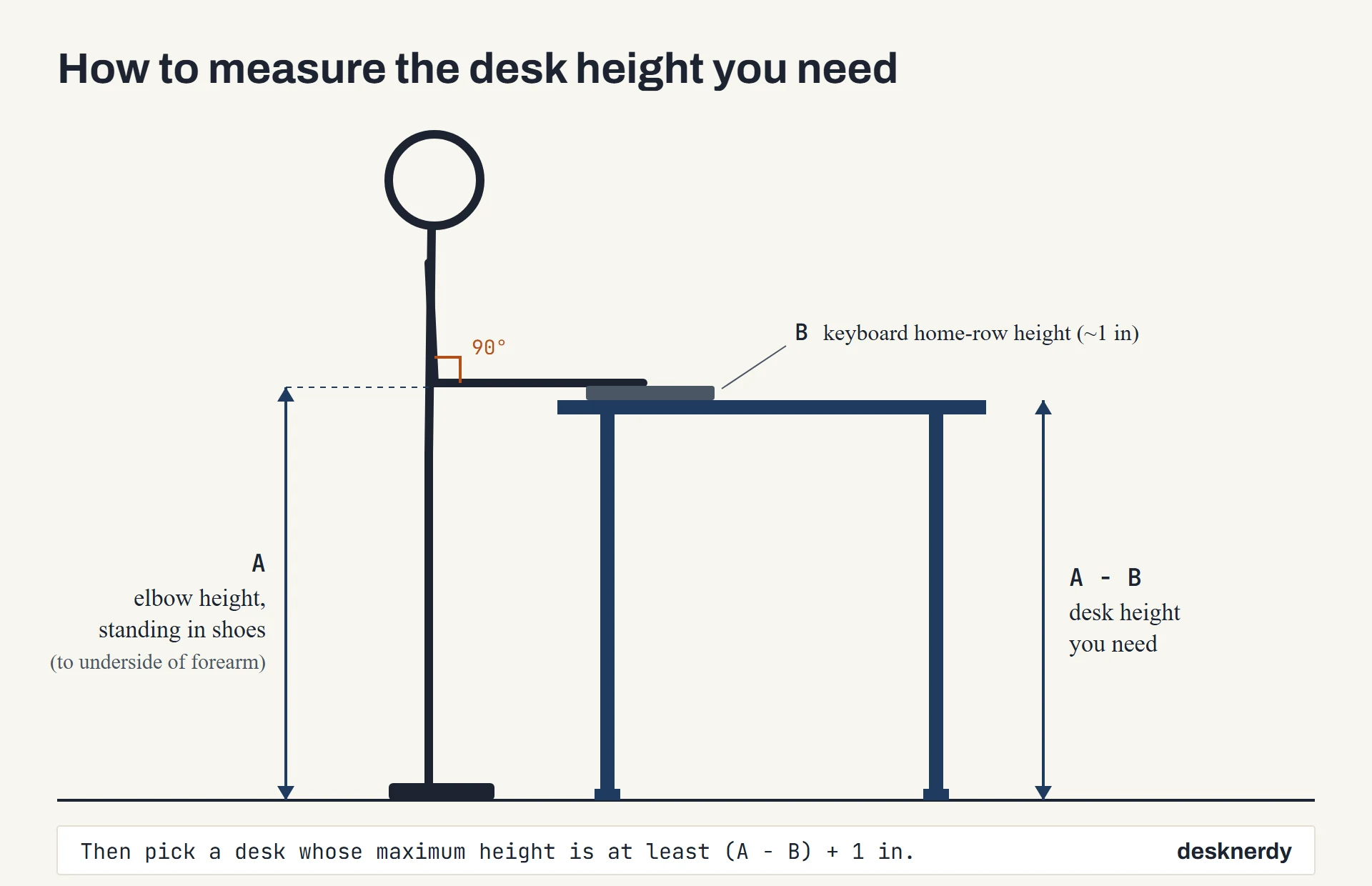
Stand in the shoes you work in, let your upper arms hang and bend your elbows to 90°. Have someone measure from the floor to the underside of your forearm. Subtract how far your keyboard’s home row sits above the desk. That’s your desk height.
Then add about an inch, so you aren’t running the desk at its very top every day. Repeat it sitting in your chair, since the desk also has to go that low. The iMovR’s extenders lift its bottom setting to about 30.4 in.
What to check besides maximum height
Does the listed height include the desktop?
Not always, and it’s the mistake that costs tall buyers most. Pick by pick: both FlexiSpot frames, the Desky and the iMovR (on its extender page) publish frame-only numbers, so you add your top. Autonomous and Vari measure to the desktop surface. Herman Miller doesn’t say, so ask before you order.
Here’s how the sum goes. The E7 Plus frame tops out at 51.6 in, so a 1 in top puts your keyboard surface at 52.6 in. FlexiSpot asks for a top over 0.7 in (18 mm) thick, and the thinnest one it allows gives about 52.3 in.
Will it be stable near the top?
Tall users run their desks near full extension every day, and that’s where wobble shows up. Cult of Mac found the UPLIFT V3 rock solid at standing height but noticed a slight tremor at its maximum.
Say you type hard with two monitors on a clamp-on arm. Any shake in the legs travels up the arm, so the screens bob while you work. Three-stage legs and a four-leg frame are what to look for, and our standing desk wobble guide covers fixes.
Anti-collision and clearance above the desk
Anti-collision stops the desk when it meets an obstacle. All seven picks list it, the Jarvis only with its programmable handset. It doesn’t replace checking the space above and behind the desk.
At full height, a tall user’s desk rises toward shelves, window sills and wall-mounted screens. If a shelf hangs over the back edge, measure the gap with the desk at its top before you mount anything. The power cables also need enough slack for the whole trip.
Returns, warranty and assembly
Vari, FlexiSpot and Autonomous cover return shipping within the US mainland. Herman Miller charges a restocking fee, and Desky’s buyer pays to ship it back. iMovR gives 100 days but may deduct a fee.
The Vari ships with its frame already on the top, and iMovR says the Lander arrives mostly assembled. Most of the others need a second person to flip the finished desk upright, so book a helper before the boxes arrive.
Why there’s no budget pick
Height, mostly. The single-motor entry frames top out lower: VIVO’s DESK-1B1B lists 48.2 in and FlexiSpot’s EN1 48.6 in, and neither says whether that includes the top.
Say you’re 6’5″. The target is roughly 48.5 in, so the VIVO misses if its figure already counts the top and barely scrapes by if it doesn’t. If cost matters, the E7 Plus is sold as a frame only, which lets you reuse a top you already own.
Monitor height
A desk at elbow height still leaves a laptop or a short monitor stand low for a tall user. Plan on a monitor arm so the top of the screen sits near eye level.
How we picked these 7 desks
Every desk had to reach 50.1 in with a 1 in top: the 6’6″ line plus an inch of headroom. When a maker doesn’t say whether its figure includes the top, we took the figure as listed, which is the lower reading.
It also had to list a lift capacity, a warranty and return terms, and be on sale now. We kept one desk per need; others that qualified are under Also considered.
Picks are researched, none were tested hands-on (how we research). Each Source line dates the maker pages behind a pick. A third-party review counts only if it covers the same model; when it tested a different size, the pick names that size.

The bottom of the range matters if a shorter person sits at the same desk. The Autonomous comes down to 24.25 in. The iMovR starts lower without its extenders and higher than any other pick with them, at about 30.4 in.
Best overall: FlexiSpot E7 Plus (4-leg)
Start with the E7 Plus unless you’re over 6’9″. With a typical 1 in top it clears the 6’10” line by 0.9 in. Its four legs answer what tall users worry about most: wobble near full height.
The maximum is for the bare frame, so add your top. With a 1 in top you get 52.6 in; a 1.5 in butcher-block top gives about 53.1 in. Say you’re 6’9″ and want a deep top for two monitors: your target is about 51 in, so even the 1 in top leaves 1.6 in spare.
FlexiSpot publishes no noise rating, and at 1 in/s the E7 Plus is the slowest lifter here. If you share the room or take calls while it moves, the Desky Dual is the frame with a published noise rating.
The Gadgeteer (May 2, 2024) built it with a 79 x 35 in bamboo top and called it “shockingly stable”. GameRevolution (Aug 20, 2026) said the four legs reduce wobble. MobileSyrup (Oct 5, 2024) built it alone from online videos because the printed instructions didn’t help.
Watch the name when you order. The E7, the E7 Pro and the older E7 Pro Plus are different frames with lower maximums. You want the page titled “4-leg Standing Desk (E7 Plus)” with the standard height option. The E7 Plus Fit option stops at 45.7 in; it’s for shorter users.
The frame adjusts from 38.9 to 62.6 in wide, so measure your wall space first.
Pros
- Four three-stage legs, steadier near the top than two
- Reaches past 6’10” with an ordinary top
- Frame-only option for a top you own
Cons
- Slowest lift of the six that publish a speed
- No published noise rating
- Heavy frame; plan on two people
Specs
- Height range: 26–51.6 in without a top (27–52.6 in with a 1 in top)
- Measured to: frame only
- Lift capacity: 540 lb static / 440 lb lifting
- Legs: 4, 3-stage
- Motors: 2
- Speed: 1 in/s
- Noise: not published
- Presets: 4
- Anti-collision: yes, 4 sensitivity levels (manual)
- Warranty: 15 years frame, motors and electronics; desktop 2–5 years by material
- Returns: 30 days, no restocking or return-shipping fee on standing desks (continental US)
- Assembly: ships as parts, frame in two boxes
Source: FlexiSpot E7 Plus product page and manual (viewed Nov 1, 2026) and shipping and returns policy (viewed Oct 26, 2026). Sold in the US.
Skip it if
- Your wall space is under 47.2 in, the length of FlexiSpot’s shortest listed top.
- You’d rather not add up frame and top heights at all. The Autonomous or the Vari is measured to the surface.
Best complete desk for 6’7″ and up: Autonomous Desk Pro AI
The Autonomous Desk Pro AI is the tallest complete desk here, and its maximum is measured from the floor to the top of the desktop. No guessing about top thickness. With an inch to spare, it suits people up to about 6’11”.
Say you’re 6’10” and want one box with one number. The estimate says 51.7 in; the Autonomous goes to 53.5 in, so 1.8 in is left over for thick-soled shoes or a lower keyboard.
Where it falls short: it’s a two-leg C-frame with no front crossbar and no published stability figure at full height. There’s no independent review of the Pro AI itself yet. If wobble worries you, the E7 Plus is the safer bet; otherwise run the Autonomous to the top with your monitors on it inside the 30-day return window.
Check the listing name, too. The standard Desk Pro sold on the same page is a lower frame, 29.5–48.5 in with a 330 lb rating.
Pros
- No desktop math: height is to the work surface
- Anti-collision with adjustable sensitivity
- Quietest noise rating listed here
Cons
- Two-leg C-frame, with leg stages not published
- Only two desktop sizes
- Short desktop warranty
Specs
- Height range: 24.25–53.5 in
- Measured to: floor to work surface
- Lift capacity: 450 lb
- Legs: 2 (C-frame), stages not published
- Motors: 2
- Speed: 1.2 in/s
- Noise: under 30 dB
- Presets: 3
- Anti-collision: yes, sensitivity 0–8
- Warranty: frame lifetime, top 2 years
- Returns: 30 days, free returns
- Assembly: 13-step guide; two people to flip it upright
Source: Autonomous Desk Pro product page and assembly guide (both viewed Nov 1, 2026). Sold in the US.
Skip it if
- You’re under about 6’5″: the extra range buys you nothing.
- You want a desktop wider than 70.5 in or plan to fit a top of your own.
Best for 6’10” and up: iMovR Lander with height extenders
Buy the Lander for its 6 in height extenders, not for the desk on its own. Without them it stops around the 6’8″ line. With them, it gets past every other pick by more than an inch, whichever iMovR figure you go by.
Say you’re 7’1″. That works out to about 53.6 in, which the Autonomous misses by a hair and the extended Lander clears with room left.
iMovR’s own numbers disagree, so read them carefully. The extender page lists the base at 23.4–49.4 in without a top, while the 2025 manual gives 22.75–48.75 in including the top. The product page adds a Lander 2.0 range of 23–49.125 in to the surface, and iMovR doesn’t say which generation ships.
The table and Specs here use the extender page’s frame-only figures, so add your top to them. By the manual’s figure, the plain Lander would stop near 6’5″.
Work While Walking (Feb 1, 2023) ran the motors for five minutes under a 360 lb load without a shutdown, on an older generation with slower columns.
Fitting the extenders means lowering the desk, flipping it upside down with a helper and reprogramming the controller for the new range. They lift the bottom of the range as well.
Pros
- Reaches past 7 feet once the extenders are on
- Arrives mostly assembled
- 100-day satisfaction guarantee
Cons
- Extenders raise the lowest setting as well
- Fitting them means flipping the desk and reprogramming it
- Restocking fee in some cases
Specs
- Height range: 23.4–49.4 in base; 29.4–55.4 in with 6 in extenders (manual: 22.75–48.75 in including top; Lander 2.0: 23–49.125 in to the surface; generation shipped not stated)
- Measured to: frame only (extender page); the manual figure includes the top
- Lift capacity: 300, 450 or 600 lb by configuration (category page); 315 lb excluding top (manual)
- Legs: 2 columns, stages not published
- Motors: 2
- Speed: 1.6 in/s (Classic) / 3.2 in/s (Lander 2.0); generation shipped not stated
- Noise: not published
- Presets: not published as a number (app favorites)
- Anti-collision: yes
- Warranty: lifetime frame; 10 years motors, electronics and laminate tops
- Returns: 100 days; up to 20% restocking fee in some cases; shipping not refunded
- Assembly: 75% pre-assembled; two people to flip
Source: iMovR height extenders page and Lander manual (viewed Nov 1, 2026); Lander product page (viewed Oct 12, 2026). Sold in the US.
Skip it if
- Someone shorter needs to sit at the same desk.
- You’re under about 6’8″: a simpler desk here reaches you without the extra steps.
Best premium build: Herman Miller Jarvis (3-stage)
The Jarvis is the desk Fully made popular, now sold by Herman Miller. With the regular 3-stage base, its listed maximum clears the 6’8″ line, and it lifts faster than the E7 Plus or the Autonomous by the makers’ figures.
Herman Miller lists that maximum next to a 1 in top thickness but doesn’t say whether the range includes it. A pop-up on the same page says 51.25 in; the table and Specs here use the spec table’s 51.1 in.
If the top is extra, you’d get about 52.1 in. If you’re 6’9″ or taller, ask Herman Miller which it is before you order.
Say you’re 6’7″. Your desk should reach about 49.8 in, so the Jarvis leaves 1.3 in to spare if the top is included and 2.3 in if it isn’t. Either way you’re covered.
Pick the base carefully. The 2-stage base stops at 49.4 in and the “3 Stage Low” at 43.4 in, so the wrong option won’t reach a tall user. Presets and anti-collision come with the programmable OLED handset; the default Up/Down handset has no preset buttons, and Herman Miller lists no collision detection for it.
Pros
- Regular 3-stage base clears 6’8″ on paper
- Programmable handset with presets
- Lifts faster than the E7 Plus or the Autonomous
Cons
- Two of the base options won’t reach a tall user
- Restocking fee on returns
- Presets cost a handset upgrade
Specs
- Height range: 25.6–51.1 in (3-stage base)
- Measured to: not stated
- Lift capacity: 350 lb
- Legs: 2, 3-stage
- Motors: not published as a number
- Speed: 1.5 in/s
- Noise: under 50 dB
- Presets: 4 on the programmable OLED handset; none on Up/Down
- Anti-collision: on the programmable handset (Jarvis manual); not stated for Up/Down
- Warranty: 7 years for the frame, motors and electrical parts; 5 years top
- Returns: 30 days; 10% restocking fee; shipping not refunded
- Assembly: requires assembly; flip with a helper
Source: Herman Miller Jarvis Laminate product page, returns page and assembly instructions (viewed Nov 1, 2026). Sold in the US.
Skip it if
- You’re 6’8″ or taller and need a confirmed number before you buy.
- You might send it back: the fee and the unrefunded shipping make returns costly.
Best for easy setup: Vari Electric Standing Desk (60×30)
The Vari is the least fuss for a tall buyer who wants one order and one number. The frame comes mounted on the 60×30 top, the legs slide and lock, and Vari measures its maximum to the top of the desktop.
Say you’re 6’6″ with a laptop and one monitor. You need about 49.1 in, and the Vari’s 50.5 in leaves 1.4 in to spare. Your gear won’t come anywhere near the load limit.
Both independent reviews tested the smaller 48×30 version. The Gadgeteer (Feb 26, 2024) found it “super solid” with quiet motors and saw about 50.7 in on the display at full height. TechRadar (Apr 17, 2024) called it stable with minimal wobble.
The trade-off is capacity. Vari rates the 60×30 at 200 lb, while TechRadar lists 220 lb for the smaller desk. For a solid-wood top or a heavy multi-monitor rig, the FlexiSpot frames above leave far more margin.
Pros
- Frame comes pre-installed on the top
- Height measured to the desktop
- Lifetime warranty and free return shipping
Cons
- Lowest lift capacity here
- No published speed or noise figures
Specs
- Height range: 25–50.5 in
- Measured to: top of the 1.25 in desktop
- Lift capacity: 200 lb
- Legs: 3-tier
- Motors: not published
- Speed: not published
- Noise: not published (“whisper-quiet”)
- Presets: 4
- Anti-collision: yes (drop-stop sensor)
- Warranty: lifetime, original buyer
- Returns: 30 days; Vari pays return shipping (US and Canada)
- Assembly: frame pre-installed; slide-and-lock legs
Source: Vari Electric Standing Desk with ComfortEdge 60×30 page, warranty and returns pages (viewed Nov 1, 2026). Sold in the US and Canada.
Skip it if
- Your setup is heavy: a solid-wood top, a desktop tower on the surface or several large monitors.
- You’re 6’7″ or taller.
Check price on Amazon · See at Vari
Best for a big desktop: FlexiSpot E7 Plus Max (4-leg)
The Max is the E7 Plus for people who want a long top. It takes tops up to 94.5 in long, where the E7 Plus stops at 78.7 in, and it’s rated to lift half as much again.
Say you’re 6’8″ and want an 80 in top for a two-monitor setup with a printer at one end. The E7 Plus can’t take that length; the Max can, and with a 1 in top it reaches 52.4 in, 0.7 in past the 6’10” line.
In a review FlexiSpot sponsored, a glass of water barely rippled as the desk moved (Make Tech Easier, Jan 16, 2026). CGMagazine (Aug 22, 2026) called it rock-solid, without measurements.
FlexiSpot names its 2.0 option at 793 lb, but the spec tab still shows 660 lb, so that’s the figure here. It’s more than most home offices will ever load, unless yours doubles as a workbench.
Pros
- Highest lifting rating of the seven
- A motor in each of the four legs
- Takes tops up to 94.5 in long
Cons
- Frame won’t narrow below 43.3 in
- Preset count and noise not published
- Two heavy frame boxes of 61.5 lb each
Specs
- Height range: 25.8–51.4 in without a top (26.8–52.4 in with a 1 in top)
- Measured to: top of the frame, no desktop
- Lift capacity: 660 lb lifting; static not published
- Legs: 4, 3-stage
- Motors: 4
- Speed: 1.5 in/s
- Noise: not published
- Presets: memory keys 1 and 2 plus sit and stand; count not published
- Anti-collision: yes, 4 sensitivity levels (manual)
- Warranty: 15 years (frame, motors, electronics); desktop 2–5 years by material
- Returns: 30 days, no restocking or return-shipping fee on standing desks (continental US)
- Assembly: frame in two boxes; FlexiSpot advises two people
Source: FlexiSpot E7 Plus Max page and manual (viewed Nov 4, 2026) and shipping and returns policy (viewed Oct 26, 2026). Sold in the US.
Skip it if
- Your top is under 79 in and your setup is ordinary: the E7 Plus reaches 0.2 in higher and has more reviews behind it.
Best quiet frame for your own top: Desky Dual frame
The Desky Dual is the frame to buy if you already have a top and share the room. Desky rates it at 40 dB in motion, the lowest figure of any pick except the complete Autonomous. FlexiSpot and iMovR, which also sell their frames bare, publish no noise figure at all.
Say your partner takes calls a few feet away and you switch heights a dozen times a day. A frame with a published low noise rating is the one you can actually compare, and this is it. It also stores four heights on the controller and six in the app.
Height is the limit. Desky states a fit range of 5’0″ to 6’9″, but with a 1 in top and an inch to spare, it really suits people up to about 6’6″. Taller than that, look at the E7 Plus.
Desky’s pages disagree on load and speed: the product page lists 330.7 lb including the desktop and 1.6 in/s loaded, the spec sheet 308.6 lb and 1.4 in/s. Neither gap changes who it suits.
Pros
- Quietest rated of the bare frames here
- Adjustable anti-collision sensitivity
- Sold in the US, Canada and Australia
Cons
- Lower reach than the FlexiSpot frames
- Buyer pays return shipping
- Short Australian return window
Specs
- Height range: 23.6–49.2 in without a top (24.6–50.2 in with a 1 in top)
- Measured to: top of the frame, no desktop
- Lift capacity: 330.7 lb (product page) / 308.6 lb (spec sheet)
- Legs: 2, 3-stage
- Motors: 2
- Speed: 1.6 in/s loaded (product page) / 1.4 in/s (spec sheet)
- Noise: 40 dB
- Presets: 4 on the controller, 6 in the app
- Anti-collision: yes, adjustable
- Warranty: 10 years frame, motors and electronics; 5 years desktop
- Returns: 30 days (Canada, US), buyer pays return shipping; 7 days (Australia)
- Assembly: two boxes; Desky says under 30 minutes
Source: Desky Dual Sit Stand Desk Frame pages on desky.ca, desky.com and desky.com.au, plus the spec sheet (viewed Nov 1, 2026). Sold in Canada, Australia and the US.
Skip it if
- You’re 6’7″ or taller.
- You want a desk that arrives with its top.
Electric or manual for tall users?
Electric, in almost every case. A tall user moves the desk a long way between sitting and standing: these frames travel 25.5 to 29.25 in from bottom to top (Vari, Autonomous).
Say you sit down and stand up twice a day. That’s four trips of 25 in or more on a crank, every day. A crank is cheap and hard to break; turning it four times a day is the part nobody budgets for. Weighing a crank model anyway? See electric vs manual standing desks.
Will a desk riser work if you’re tall?
Up to about 6’2″, usually; past 6’4″, rarely. On a standard 30 in fixed desk, a riser has to lift your work surface about 16.6 in at 6’2″, 17.9 in at 6’4″ and 19.1 in at 6’6″.
Of the five converters here, only the VIVO K Series lists more than 18 in. Five of the eight in our converter guide do, up to 20.1 in on the FlexiSpot AlcoveRiser M7.
None of the five says what its maximum is measured to, and a keyboard tray sits lower than the main surface, so treat these as best-case figures. Our standing desk converter guide has the full list.
| Converter | Listed max height | Covers (on a 30 in desk) |
|---|---|---|
| VIVO K Series (DESK-V000K) | 20 in | Up to about 6’6″ |
| Desky Zero | 17.5 in (without desktop) | About 6’2″ |
| VIVO DESK-V028S | 17.2 in | About 6’2″ |
| VIVO V Series (DESK-V000V) | 17 in | About 6’2″ |
| VIVO DESK-V000VLE (electric) | 16.7 in | About 6’2″, with almost nothing to spare |

A lower fixed desk makes it worse. Say yours is 29 in: at 6’4″ the riser now has to make up 18.9 in, and only the VIVO K Series lists that much. We compare the two routes in standing desk vs desk converter.
Also considered
These meet the same height, spec and on-sale rules, but a pick above does the same job better.
- UPLIFT V3: 48.7 in with a 1 in top as sold. It qualifies only with UPLIFT’s foot spacers, which take the frame to 49.9 in.
- FlexiSpot E7 Pro: lists 25–50.6 in and 440 lb static; the E7 Plus reaches at least an inch higher on four legs.
- FlexiSpot Fusion Retro: a drawer desk listed at 26.6–52 in and 275 lb; the E7 Plus reaches about as high on four legs.
- The Grovemade Desk: listed at 25.25–50.5 in and 270 lb, with 15-day returns; the Jarvis reaches 0.6 in higher with a 7-year frame warranty.
- Oakywood Standing Desk Pro: lists 24.8–50.4 in and under 40 dB, made in Poland. Its 154 lb rating is below the Vari’s 200 lb.
- VIVO 2B Split Top 71 x 30 (DESK-KIT-2B7B): a dual-motor desk listed at 24.5–50.3 in and 220 lb, with a 3-year warranty and no stated anti-collision.
- Desky Quad frame: four legs and 661.4 lb, 50.2 in with a 1 in top. The E7 Plus Max reaches 2.2 in higher, and Desky’s buyer pays return freight.
Desks we ruled out
- UPLIFT V2 / V2-Commercial: retired. Both V2 product links now open UPLIFT’s V3 page.
- FlexiSpot E7 Pro Plus: FlexiSpot now sells this frame as the Premium Standing Desk (E7), listed at 22.8–48.4 in without a top, about 6’6″ by our estimate. There’s no current Pro Plus page; the E7 Plus above replaces it.
- Branch Standing Desk: the old product link now opens Branch’s Tria desk, which lists 25.5–48.9 in.
- Branch Duo: 28–47.3 in, too low past about 6’2″.
- Rise Up Bamboo: retailers list five different height ranges for the same desk, with no maker spec sheet to settle which is right.
- ApexDesk Elite Pro Series 71: 30–49 in on its product page and lower without the desktop in its manual, short of the 6’6″ line with room to spare.
- ErgoMax dual-motor frame: ErgoMax lists only a general range topping out at 48 in, too low for tall users.
FAQ
What is the tallest standing desk?
Here, the iMovR Lander with its 6 in height extenders goes highest. Without add-ons, the Autonomous Desk Pro AI leads. That’s out of the desks compared above, not every desk on sale.
Do wheels make a standing desk taller?
Yes, by the height of the casters. UPLIFT’s optional casters add 1.5, 2.5 or 4.7 in to the V3. Lock them before you work at full height.
Is a regular standing desk tall enough for a 6-foot person?
Yes. At 6’0″ the estimate is about 45.4 in to the desktop, and every pick here clears it by more than 3 in. At that height, buy on stability, desktop size and returns; our guide to choosing a standing desk shows what to read on the spec sheet.
Data sources
- CCOHS, sit-stand desks
- OSHA eTool, keyboards
- Elbow height ≈ 0.63 × stature: Drillis & Contini (1966) body-segment proportions, as reproduced in D. A. Winter, Biomechanics and Motor Control of Human Movement
- Converter heights: VIVO product pages for K Series, V Series, DESK-V028S, DESK-V000VLE; Desky Zero (viewed Oct 12, 2026)
What changed: November 14, 2026 — We corrected the riser note: five of the eight converters in our converter guide list more than 18 in of rise.