Researched · body-proportion estimates, OSHA and CCOHS workstation guidance and maker spec sheets compared, not hands-on
The correct standing desk height puts the keyboard’s home row level with your elbows. For adults from 5’0″ to 6’4″ in everyday shoes, that means a desktop at about 37.8 to 47.9 in (96 to 122 cm).
The quick estimate is 0.63 × your height in inches. At 5’10” (70 in), the desktop goes at 44.1 in (112 cm); your elbow sits 1 in higher, level with the home row.
The calculator runs the same math. Change the shoe and keyboard boxes if yours aren’t the 1 in defaults, or enter a measured elbow height.

On this page · 9
Standing desk height chart, 4’10” to 6’8″
Each row uses the calculator’s formula. Your bare elbow sits at about 0.63 × your height. A 1 in sole adds an inch, and the 1 in from desk to home row takes it back. The third column is your eye height in shoes: the top of your monitor goes no higher.

| Your height | Desktop height, standing (est.) | Eye height standing, in shoes (est.) |
|---|---|---|
| 4’10” (147 cm) | 36.5 in | 55.3 in |
| 5’0″ (152 cm) | 37.8 in | 57.2 in |
| 5’2″ (157 cm) | 39.1 in | 59.0 in |
| 5’4″ (163 cm) | 40.3 in | 60.9 in |
| 5’6″ (168 cm) | 41.6 in | 62.8 in |
| 5’8″ (173 cm) | 42.8 in | 64.6 in |
| 5’10” (178 cm) | 44.1 in | 66.5 in |
| 6’0″ (183 cm) | 45.4 in | 68.4 in |
| 6’2″ (188 cm) | 46.6 in | 70.3 in |
| 6’4″ (193 cm) | 47.9 in | 72.1 in |
| 6’6″ (198 cm) | 49.1 in | 74.0 in |
| 6’8″ (203 cm) | 50.4 in | 75.9 in |
Use the chart for a first preset. If your shoulders creep up while you type, the desk is high. If your wrists bend up, it’s low.
Worked examples, from 5’6″ to a person 6 feet tall and up
At 5’6″ the estimate is 41.6 in, and at 5’8″ it’s 42.8 in (109 cm). A 6-foot person gets 45.4 in. At 6’2″ it’s 46.6 in, at 6’4″ it’s 47.9 in (122 cm), and 6’6″ needs 49.1 in.
Add 1 in of headroom when you shop. Say you’re 6’4″: a desk that stops right at your estimate leaves no room for a thicker sole, so look for 48.9 in or more. Only 37 of the 88 adult standing desks and frames in our database reach that; our tall-person picks name the models.
How to measure your own elbow height
The 0.63 ratio is an average. A long torso or long forearms move your elbows off it, so one tape-measure reading with a helper beats the whole chart.
- Put on the shoes you work in. Every inch of sole moves the answer an inch. No helper? Stand sideways next to a wall or door frame and mark the underside of your forearm with a sticky note in step 4.
- Stand tall, upper arms hanging loose, elbows close to your sides.
- Bend your elbows until your forearms are level with the floor.
- Measure from the floor to the underside of your forearm at the elbow. Call it A.
- Measure from the desktop to the top of your keyboard’s home row (the A to L keys). Call it B. Your desk height is A minus B.
- Enter A in the calculator’s measured-elbow box, set the desk and save it as a preset.
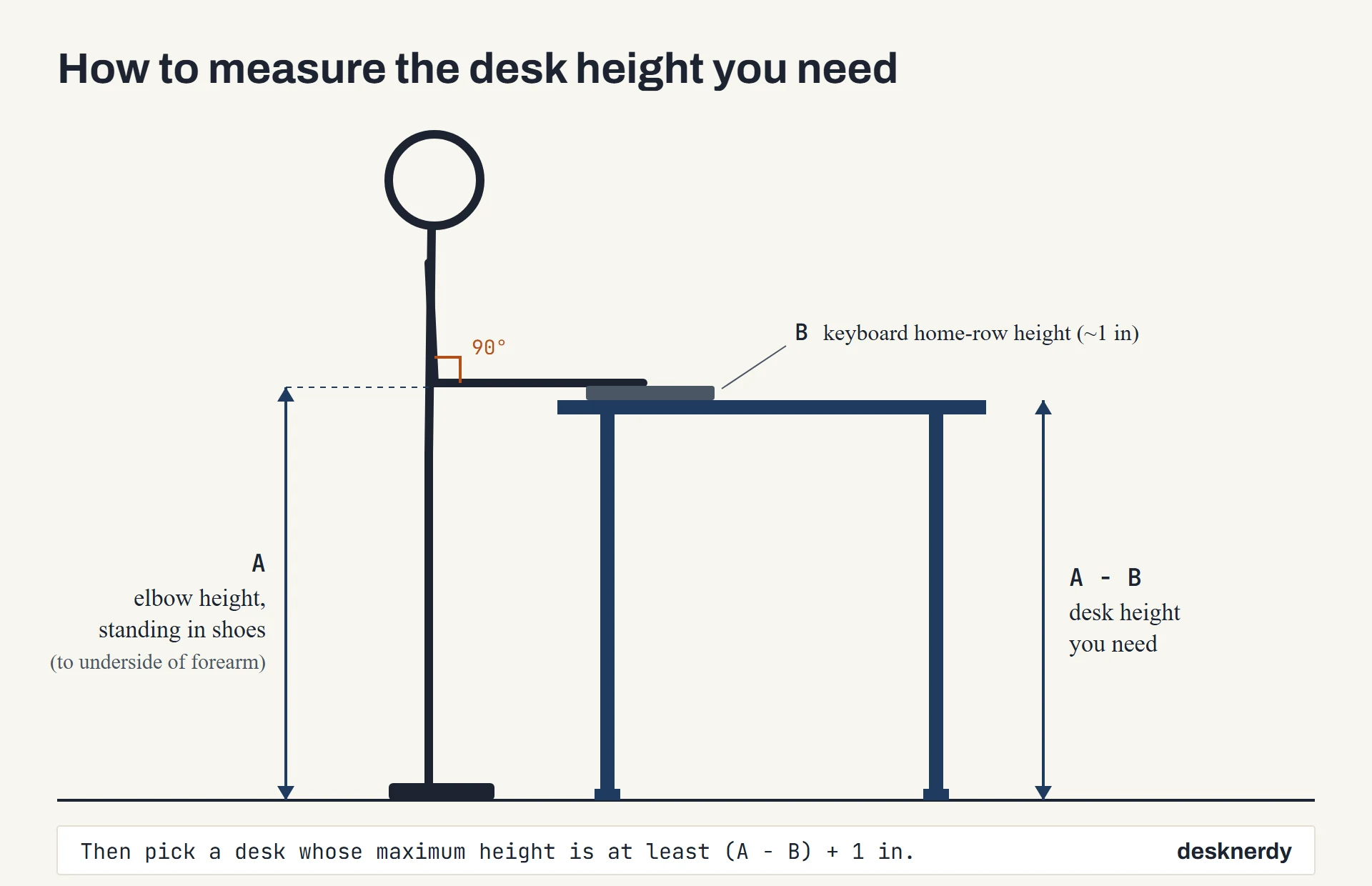
CCOHS, Canada’s occupational health and safety agency, puts a standing work surface “approximately at your standing elbow position.” Elbows stay close to the body, bent at about 90 degrees. OSHA’s keyboard guidance wants elbows “about the same height as the keyboard.”
How do I calculate my standing desk height?
It takes three lines, all in inches. Say you’re 5’10” (70 in) and work in sneakers with a 1 in sole:
- Elbow height in shoes = 0.63 × 70 + 1 = 45.1 in.
- Desktop height = elbow height − home-row height = 45.1 − 1 = 44.1 in.
- Shopping target (the desk’s listed maximum should reach this) = desktop height + 1 in of headroom = 45.1 in (115 cm).
If your shoes or keyboard aren’t 1 in, adjust by the difference. A 1.5 in sole raises the desktop half an inch; a mechanical keyboard with a 1.5 in home row lowers it half an inch.
A keyboard tray moves the target to the tray. Say you’re 6’0″ and the tray hangs 2 in below the desktop: the tray belongs at 45.4 in, so the desktop goes up to 47.4 in.
The 0.63 ratio comes from Drillis and Contini’s 1966 body-segment proportions, as reprinted in David A. Winter’s Biomechanics and Motor Control of Human Movement. The eye-height column uses the same table. It’s a population average published in 1966, not a measurement of you, which is why your own elbow reading wins.
Should the desk be at elbow height or slightly below it?
Slightly below is fine; above isn’t. With the home row at elbow height, the desktop itself sits about 1 in under your elbow. OSHA’s working-positions page allows an elbow angle “between 90 and 120 degrees.” A wider angle means a lower keyboard, as long as your wrists stay straight.
Going higher costs you at the shoulders: with the keyboard too high, OSHA says “you may need to raise your shoulders.” Say the desk ends up 2 in above your elbows. Lower it until your forearms are level or tilt slightly down.
Why other calculators give different numbers
Most land within an inch or two of each other. Inch Calculator gives a 5’8″ person 41 to 43 in, and our answer sits near the top of that band. Omni Calculator gives 5’9″ a range of 41.5 to 45 in; ours is 43.5 in.
The ranges come from elbow-angle leeway: 70 to 135 degrees at Inch Calculator, 90 to 100 at Omni. Our number puts the home row at the elbow, the top of that leeway. If two calculators disagree, your tape measure settles it.
Is there a standard standing desk height?
No single one, because the target is your elbow. Across the chart it moves about 14 in, from 36.5 in at 4’10” to 50.4 in at 6’8″. That’s why a standing desk is height-adjustable: one size would fit about as well as one-size shoes.
For a typical or average standing desk height, the middle of the chart is the honest answer: 40.3 to 42.8 in from 5’4″ to 5’8″. For computer work, the standard that matters is your own elbow.
What does exist is guidance for the range a desk should cover. UPLIFT says its V3 meets ANSI/BIFMA ergonomic guidance (G1-2013) and is designed to fit over 95% of users, from 5’0″ to 6’3″. The formula agrees: 6’3″ needs about 47.3 in, and the V3 reaches 48.7 in with a 1 in top.
Say you share the desk with someone 8 in taller than you. Your two numbers sit about 5 in apart, so the desk needs a range that covers both, plus two memory presets.
Where should the monitor be on a standing desk?
Higher than most setups leave it. OSHA’s monitor guidance puts the top of the screen “at or slightly below eye level” and its center 15 to 20 degrees under your line of sight. CCOHS says a standing user should view it between horizontal and 35 degrees down.
| What to set | Target | Who says so |
|---|---|---|
| Top edge of the screen | At eye level or a little lower | OSHA |
| Eye-to-screen distance | 20 to 40 in (50 to 100 cm) | OSHA |
| Center of the screen | 15 to 20° under eye level | OSHA |
| Viewing angle while standing | Horizontal to 35° down from your line of sight | CCOHS |
The gap from desktop to the top of the screen grows with your height: about 20.0 in at 5’2″, 21.8 in at 5’8″ and 23.6 in at 6’2″. It’s eye height minus desk height, or 0.306 × height + 1 in.

Say you’re 5’8″ and your screen’s top edge sits 15 in above the desktop on its stock stand. That’s almost 7 in short, and your neck makes up the difference. A laptop needs a stand and a separate keyboard to get there. For a desktop screen, a monitor arm bridges the gap and follows you between sitting and standing.
Sitting height: set the chair first
The formula doesn’t cover sitting desk height, because that depends on the chair. Sit the way you work, feet flat on the floor or a footrest, and measure the same way. Save it as a second preset. Our standing desk ergonomics checklist covers the rest of the setup.
What chair or stool height goes with a standing desk?
For sitting, a normal office chair works because the desk comes down to meet it. Herman Miller lists the Aeron size B seat at 14.8 to 22.8 in; set the chair first, then the desk to your seated elbow.
A tall seat at a raised desk is a different job. The dealer OfficeFurniture2Go puts a seat 10 to 12 in below the work surface for sitting. For perching at a sit-stand desk, it says 4 to 8 in below the standing setting. Both are dealer rules of thumb, not a standard.
Say you’re 5’6″ with the desk at 41.6 in. Sitting tall calls for a 29.6 to 31.6 in seat: the Vari Drafting Chair (24.5 to 32.5 in) covers it, the Aeron can’t. A perch needs 33.6 to 37.6 in, past the Vari’s top, so look at a leaning stool or a taller drafting chair.
If your desk can’t reach your number
What if my height falls outside my desk’s range?
Check the maximum against your standing number plus 1 in, and the minimum against your measured sitting number. Across the 88 adult standing desks and frames in our database, the median maximum is 48.7 in and the median minimum 25.7 in (65 cm). The middle half of maximums falls between 47.2 and 49.6 in.

- Tall: standard standing desk height ranges run out in the last rows of the chart. At 6’0″, 78 of the 88 reach 46.4 in; at 6’2″, 60; at 6’4″, 37. At 6’6″ (50.1 in) it’s 19, and at 6’8″ (51.4 in) just 7. Standing desks for a tall person compares maximums.
- Short, or on a low chair: the minimum matters more. Of the 88, 26 go down to 24 in or lower and 13 to 23 in or lower. If yours stops too high for sitting, raise the chair to meet it and add a footrest. Standing desks for short people lists the lowest frames.
- Range without a desktop: 24 of the 88 quote the frame alone, so the real surface sits one desktop thickness higher. Another 17 include the top, and 47 don’t say. Frame-only: add your desktop’s thickness to the maximum. Not stated: ask the maker before you order. Our standing desk buying checklist shows how to read a height range.
Say you’re 6’4″ and looking at a frame listed at 48.5 in without its top. A 1 in desktop takes it to 49.5 in, which clears your target by about half an inch.
Does a desk converter change the math?
The target stays the same; the starting point changes. A converter sits on a fixed desk, so the lift you need is your standing desk height minus that desk’s height. Measure it to the surface your keyboard sits on, which on many converters is a lower tray, not the top platform.
| Your height | Rise needed on a 29 in desk | Rise needed on a 30 in desk |
|---|---|---|
| 5’2″ (157 cm) | 10.1 in | 9.1 in |
| 5’4″ (163 cm) | 11.3 in | 10.3 in |
| 5’6″ (168 cm) | 12.6 in | 11.6 in |
| 5’8″ (173 cm) | 13.8 in | 12.8 in |
| 5’10” (178 cm) | 15.1 in | 14.1 in |
| 6’0″ (183 cm) | 16.4 in | 15.4 in |
| 6’2″ (188 cm) | 17.6 in | 16.6 in |
| 6’4″ (193 cm) | 18.9 in | 17.9 in |
The converters in our database top out between 16 and 21 in above the desk: VIVO’s DESK-V001G stops at 16 in, UPLIFT’s E7 travels 21 in. Say your desk is 29 in and you’re 6’2″. You need 17.6 in of rise, so a 16 in model is out. Makers measure from different points, so check before you order.
Sitting works the other way. Fully lowered, a converter still adds 1.8 to 6.5 in, so a 29 in desk becomes a 30.8 to 35.5 in sitting surface. If that’s above your seated elbow, raise the chair. Standing desk vs converter covers the trade-off.
FAQ
What is a good standing desk height in mm or cm?
Multiply inches by 25.4 for millimeters or 2.54 for centimeters. At 5’4″ that’s about 1,024 mm (102 cm); at 6’0″, about 1,152 mm.
Who shouldn’t rely on this chart?
Children (the chart uses adult proportions; see standing desks for kids), adults under 4’10” or over 6’8″, and anyone whose condition changes how they stand or reach. If something hurts and keeps hurting after you adjust the desk, see a doctor or physical therapist instead of chasing a number.
Data sources
Specs are the maker’s unless we say otherwise.
- CCOHS — Office Ergonomics: Sit/Stand Desk (viewed November 7, 2026)
- OSHA Computer Workstations eTool: Monitors, Keyboards and Good Working Positions (viewed November 7, 2026)
- Elbow height ≈ 0.63 × height, eye height ≈ 0.936 × height: Drillis & Contini (1966), reprinted in D. A. Winter, Biomechanics and Motor Control of Human Movement
- UPLIFT — standing desk page (ANSI/BIFMA G1-2013 note, fit range, V3 height range; viewed November 7, 2026)
- Herman Miller — Aeron specifications (viewed November 7, 2026)
- Vari — Drafting Chair (viewed November 1, 2026)
- OfficeFurniture2Go — drafting chairs and stools guide (seat rules of thumb; viewed November 7, 2026)
- Inch Calculator — desk height calculator and Omni Calculator — standing desk height (viewed November 7, 2026)
- Desk and converter ranges: DeskNerdy’s product database of 88 adult standing desks and frames and the converters we track, from maker pages viewed October and November 2026
What changed: November 7, 2026 — We updated the desk counts to 88 models, added a chart of which desks reach tall users’ heights and corrected the perching stool height.